Downspout flushing: the clog that hides below the roofline
Most overflow starts at the downspout inlet, not in the middle of the trough. Flushing is how we prove the whole path is open.
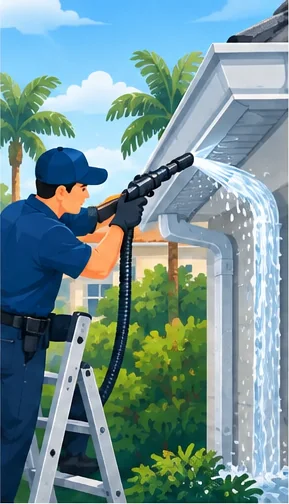
Where the blockage forms
Debris travels with the water until it reaches the narrow throat of the downspout, then wedges there. Acorns, palm boots and clumps of wet oak leaf are the usual culprits. Because the plug sits at the top or in an elbow, the gutter looks clean from the ladder while it is still filling in a storm.
A flush means running water through the downspout from the top and watching it come out the bottom. If the flow is weak or backs up, we work the plug loose and flush again until the water runs freely.
Why the outlet matters in a low-lying city
Winter Springs ground runs from roughly 76 feet above sea level in the southeast down to 3 or 4 feet at the Lake Jesup shore. On the low end there may be very little slope for water to leave a downspout, so discharge that pools by the slab can linger.
In December 2025 the city commission approved a stormwater master plan naming 46 flooding areas of interest and 12 priority locations, including Gee Creek and Lake Jesup. Downspout flushing cannot fix a district drainage problem, but it removes one avoidable contributor at your own roofline.
Underground lines and splash blocks
Some homes tie downspouts into buried drain lines that carry water out to the yard or a swale. Those lines can fill with grit and root hairs. If water gushes out of the downspout base instead of draining, mention it when we call to confirm the job, so we can look at the extension or the connector at the base. A buried line itself is a plumbing or drainage job rather than gutter cleaning.
Splash blocks and extensions are cheap fixes that carry roof water several feet from the wall. See how this pairs with a full gutter clean-out.
Do not wait for the first big storm to find the clog
A short request now gets your quote started before the wet season is in full swing.