The Winter Springs gutter guide
A plain-language look at what lands on local roofs, when it lands, and what happens if it stays.
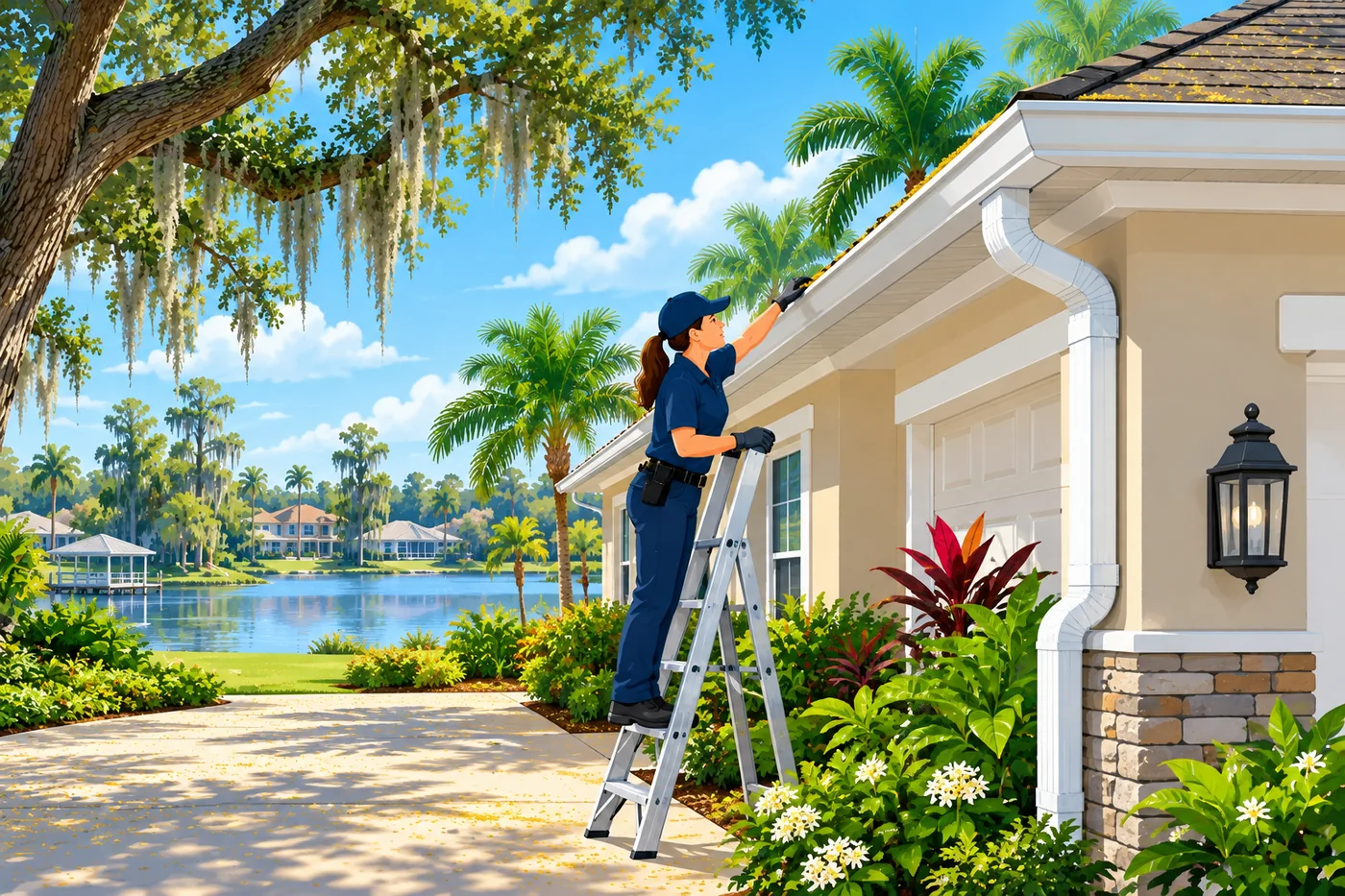
Spring: the oak drop
University of Florida extension material describes live oak as evergreen, with old leaves persisting through winter and falling gradually as new growth emerges in spring. Then come the male flowers, called catkins, followed by acorns. Mature trees can reach 60 to 80 feet tall and 60 to 120 feet wide, so one tree can overhang an entire roofline. Details at UF/IFAS Gardening Solutions.
Which Winter Springs lots have live oaks is not documented, so judge by your own yard. If a canopy reaches over the gutter, plan on a clean-out in the March to May window, before the rains build.
Summer: the wet season
The National Weather Service in Melbourne puts the start of the Orlando-area wet season around May 27, with the dry season usually starting about October 15. See the NWS wet and dry season page. Afternoon storms deliver heavy water in short bursts, which is exactly what exposes a gutter that was already half full.
The humid subtropical climate also keeps debris damp. Wet leaves rot, compact and seed, so a trough neglected in June can be far worse by September.
Storms: clear the path before the rain
The UF/IFAS disaster checklist advises clearing storm drains of branches and leaves before rain and keeping gutters and downspouts free so water flows. Find it in the UF/IFAS storm checklist.
When a named system is a few days out, schedules tend to fill, so it may help to book a clean-out earlier in the season. A clean gutter will not stop wind damage, but it is one of the few preparations that is cheap and quick.
Low ground and the flooding context
The city's terrain falls from about 76 feet above sea level in the southeast to 3 or 4 feet at the Lake Jesup shore. Creeks drain toward the lake and then the St. Johns River. Reporting by Spectrum News 13 notes that dozens of homes flooded after Ian and Nicole.
In December 2025 the commission approved a stormwater master plan, covered by Central Florida Public Media. Funding still has to be set. Until then, the best thing a homeowner can do is keep roof water moving away from the house.
Trees near the lake and the preserve
Spring Hammock Preserve covers more than 1,500 acres on Lake Jesup and is about two-thirds swamp, with ancient bald cypress and a hardwood hammock described at Florida Hikes. Sweetgum, hickory, ash, tulip poplar and cabbage palm are all on that species list.
Exactly what each species drops on nearby roofs is not documented here, but it is reasonable to expect needles, seed balls and fronds on homes close to the preserve. Treat that as an inference, not a rule.
Tree work is a separate permit question
Trimming back overhanging branches reduces what falls, but it is not gutter work, and we do not do it. The city arborist handles residential arbor permits under Chapter 5, and tree businesses working in the city must be city-licensed. State law also limits permit requirements when an arborist documents a hazard tree. The application is on the city's arbor permit form.
Check the rules first, then check your HOA. See the condo and HOA page.
Sources
Do not wait for the first big storm to find the clog
A short request now gets your quote started before the wet season is in full swing.